Symmetry / Reflection
- A plane figure is symmetrical about a line if it is divided into two identical (coincident) parts
by that line. The line is called its line (or axis) of symmetry.
- A plane figure is symmetrical about a point if every line segment joining two points of the figure and passing
through the point is bisected at that point. The point is called its point (or center) of symmetry.
- A plane figure has a rotational symmetry if on rotation through
some angle (
 180°)
about a point it looks the same as it did in its starting position.
180°)
about a point it looks the same as it did in its starting position.
- If A° ( 180°) is the smallest angle through which a figure can be
rotated and still looks the same, then it has a rotational symmetry of order 360/A.
- The reflection (or image) of a point P in a line AB is a point P' such that AB is the perpendicular bisector of the line segment PP'.
- To find the reflection (or image) of a point P in a line AB
From P, draw PM perpendicular to AB and produce PM to P' such that MP'= MP, then
P' is the reflection (or image) of P in the line AB.
- The reflection of the point P (x, y) in the x-axis is the point P'(x, -y).
- The reflection of the point P (x, y) in the y-axis is the point P'(-x, y).
- If a point P (x, y) is rotated through 180° (clockwise or
anti-clockwise) about the origin to the point P', then co-ordinates of P' are (-x,-y).
- If a point P (x, y) is rotated through 90° clockwise about the origin to the point P', then co-ordinates of P' are (y,-x).
- If a point P (x, y) is rotated through 90° anti-clockwise
about the origin to the point P', then co-ordinates of P' are (-y,x).
Exercise
- Draw the line (or lines) of symmetry, if any, of the following shapes and count their number:
(i) 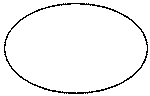 (ii)
(ii) 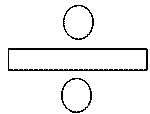
(iii)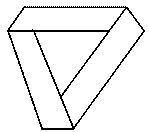
- For each of the given shape in question 1, find the order of the rotational symmetry (if any).
- Each of the following figures shows half of a symmetrical figure about a dotted line. Copy these figures in your notebook and complete them:
(i) 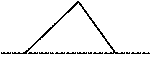 (ii)
(ii)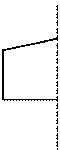
(iii) 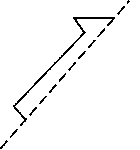
- Plot the points A (2,-3), B (-1,2) and C (0,-2) on the graph paper. Reflect the triangle
ABC in the x-axis to the triangle A'B'C'. Write down the co-ordinates of the vertices of
 A'B'C'. Are the two triangles congruent?
- A (4,-1), B (0,7) and C (-2,5) are the vertices of a triangle ABC. This triangle is reflected
in the y-axis. Find the co-ordinates of the images of the vertices.
- Plot the points A (3,-4) and B (2,5) on the graph paper. Rotate the triangle OAB through 180° about O (origin).
Find the co-ordinates of the vertices of this new triangle.
- Plot the points P (-2,3) and Q (4,-7) on the graph paper. Rotate the line segment PQ through 90° anti-clockwise about
the origin to the position P'Q'. Write down the co-ordinates of P' and Q'.
- Plot the points A (3,5), B (-2,4) and C (5,-6)
on the graph paper. Rotate the triangle ABC through 90° clockwise about the origin to the position A'B'C'. Write down the
co-ordinates of the vertices of A'B'C'.
Answers
1. (i) Two
(ii) two
(iii) none
2. (i) Two
(ii) two
(iii) three
4. A'(2,3), B (-1,-2), C'(0, 2); yes
5. (-4,-1), (0,7), (2,5)
6. (0,0), (-3,4), (-2,-5)
7. P'(-3,-2), Q'(7,4)
8. A'(5,-3), B'(4,2), C'(-6,-5)